
クラッシュアウトの意味:正直なガイド (2026)
Quick answer: the crash out meaning is blunt — to crash out means to lose your temper and react recklessly, usually because you’ve been pushed past your breaking point. Someone who is crashing out is snapping, blowing up, or doing something rash in the heat of the moment. That’s the crash out meaning in one line — but how serious it is depends entirely on tone.
If you’ve seen someone comment “bro is about to crash out” under a video and weren’t sure whether to laugh or call for help — you’re not alone. Half the time it’s genuine anger, and half the time it’s a dramatic joke about a tiny inconvenience. Let me walk you through both, where it came from, and how to use it without sounding like you’re trying too hard.
Crash out meaning: what does it really mean?
To crash out is to let your emotions take the wheel and do something you might regret — yell, throw hands, send the unhinged text, quit on the spot. It’s the moment self-control snaps.
The key word is recklessly. Crashing out isn’t calmly being upset; it’s the loud, impulsive overreaction. People usually say it about a person who was holding it together until one last thing tipped them over.
crash out = to snap and react recklessly when you’re pushed too far.
Not sure how seriously to take it? Here’s your quick read:
| トーン | It sounds like… | What they actually mean |
|---|---|---|
| Genuinely upset | “I’m gonna crash out” | A real, hard reaction — maybe check on them |
| Dramatic / joking | “I’ll crash out if this lags again” | Mock outrage over something tiny |
| Warning a friend | “don’t crash out, it’s not worth it” | Telling someone to keep their cool |
Where “crashing out” came from
This one isn’t brand new. “Crash out” has roots in African American Vernacular English, where it carried meanings like passing out, but also acting wild or self-destructing. Hip-hop kept it alive, and around 2023–2024 it exploded on TikTok as the go-to phrase for losing your composure. If you want the broader picture of how terms like this travel, our guide to 2025 emoji slang traces the same pattern.
How to use “crash out” (serious vs joking)
Context does all the work here:
- Serious: “He got the news and just crashed out.” — a real, hard reaction.
- Joking / dramatic: “If this Wi-Fi drops one more time I’m crashing out.” — mock outrage over something small.
- Warning a friend: “Don’t crash out, it’s not worth it.” — telling someone to keep their cool.
It pairs naturally with other reaction slang. If you’re still decoding the abbreviations that fly around the same comment sections, our text abbreviations list そして what “ngl” means are handy companions. According to Wikipedia’s Gen Z slang list, reaction terms like this spread fastest because they put a name to a feeling everyone already has.
Is it cringe to say “crash out”?
Honestly? It depends on who you ask. It’s extremely common, which means it can read as a little overused — but it’s nowhere near “how do you do, fellow kids” territory yet. Used naturally and sparingly, it lands fine. Spammed into every sentence, it gets old fast. If you’re curious which terms have already aged, peek at the emoji red flags that age you.
Crashing out in the wild: real examples
It helps to see it land in an actual conversation. A few everyday moments:
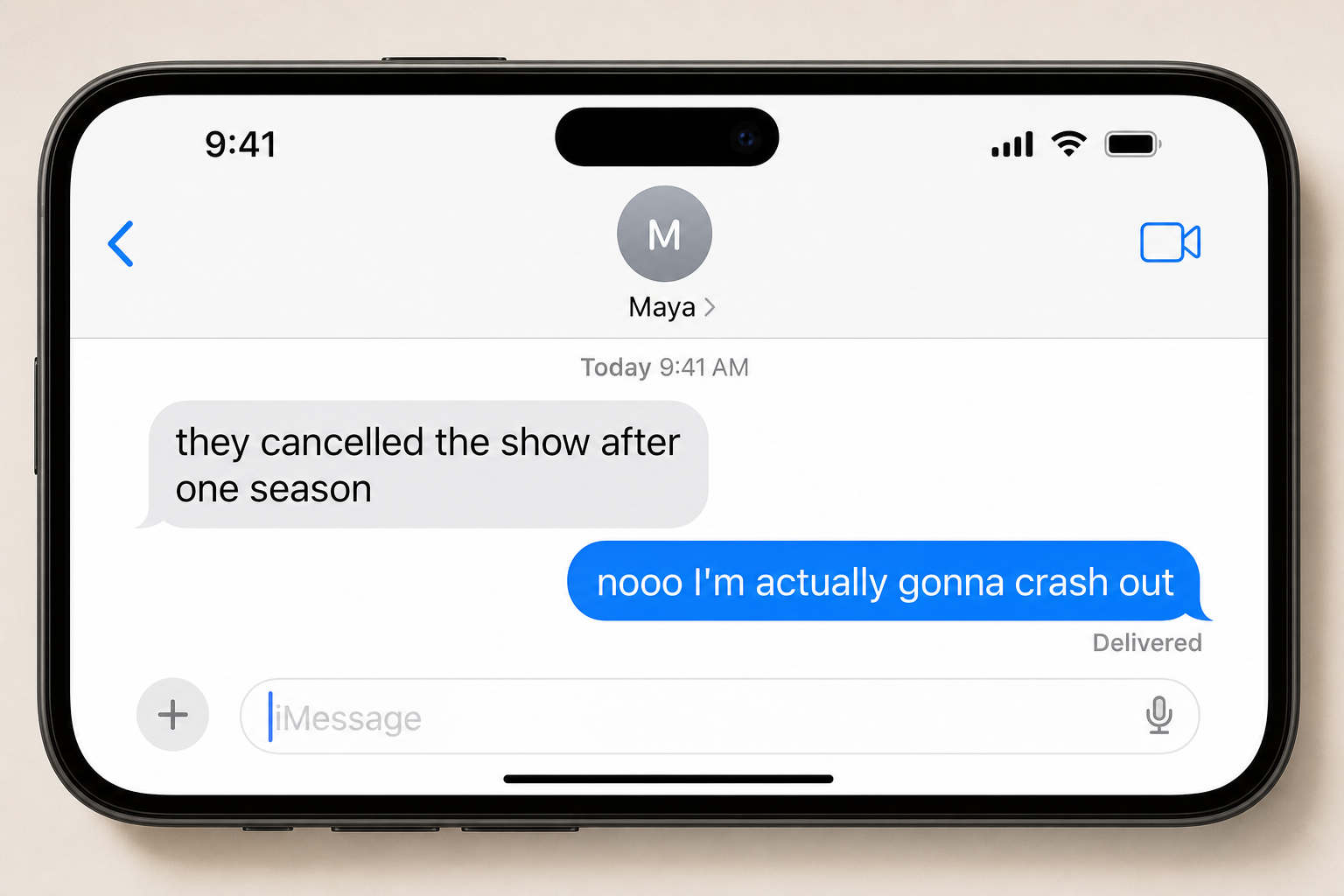
- Them: “they cancelled the show after one season.” 君だ: “no because I’m actually going to lose it, that was the best thing on TV.” — genuine frustration, dialed up for effect.
- In a group chat: “okay don’t freak out, but the trip got pushed to next month.” — softening real bad news with a warning to stay calm.
- Self-aware and silly: “lowkey spiraling over a parking ticket rn, somebody come get me.” — mock-drama over something tiny, which is most of how the phrase gets used online.
The thread connecting all three is a flash of feeling that sprints ahead of logic. Sometimes that flash is real and serious; far more often online, it is theatre — a fun, exaggerated way to say “this got to me.”
Words that travel with it
You will usually see this phrase running with the same reaction crowd: “tweaking” (acting erratic), “buggin” (overreacting), and “lock in” (the opposite — focusing up and keeping it together). If you want the wider map of how this vocabulary spreads, the text abbreviations list and our breakdown of what “sus” means sit right in the same neighborhood.
What does “crash out” mean?
To crash out means to lose your temper or self-control and react recklessly — snapping, blowing up, or doing something rash because you’re pushed past your limit. “I almost crashed out” = “I almost lost it.”
Where did “crashing out” come from?
It grew out of African American Vernacular English and hip-hop, where “crash out” long meant to act recklessly or self-destruct. It went mainstream on TikTok and in rap lyrics around 2023–2024.
Is crashing out a bad thing?
Usually, yes — it describes an overreaction you might regret. But online it’s often said half-jokingly about small frustrations (“I’m gonna crash out if this loads any slower”), so tone and context matter.
How do you use “crash out” in a sentence?
“He failed the test and crashed out on everyone,” or, lighter, “Don’t crash out, it’s just a game.” It works as a verb for losing your cool.
Is “crash out” Gen Z or Gen Alpha slang?
Both use it, but it’s especially common with Gen Z. It sits in the same family as “tweaking,” “buggin,” and “lock in.”
Is “crashing out” the same as a mental breakdown?
No, not literally. A breakdown is a serious mental-health event, while this slang usually describes a hot-headed overreaction in the moment. Read it seriously only when the situation around it is genuinely serious.
What can you say instead?
Calmer ways to put it include “losing it,” “tweaking,” or simply “I’m really frustrated.” If you mean an actual meltdown, it is kinder and clearer to name the real feeling.
Is it Gen Z or Gen Alpha slang?
Both use it, but it skews Gen Z. It rose through hip-hop and TikTok and sits beside terms like “tweaking,” “buggin,” and “lock in.”





 English
  Español de México
  Português do Brasil
  日本語
日本語  Français
  Deutsch (Sie)